In a live auction, time is never neutral. The same is true the morning your home hits the MLS.
When a listing goes live, the clock does not just count days. It writes a public story that every buyer, every agent, and every portal algorithm reads before anyone steps through the door. In Indianapolis and across Boone and Marion Counties, that story is called Days on Market.
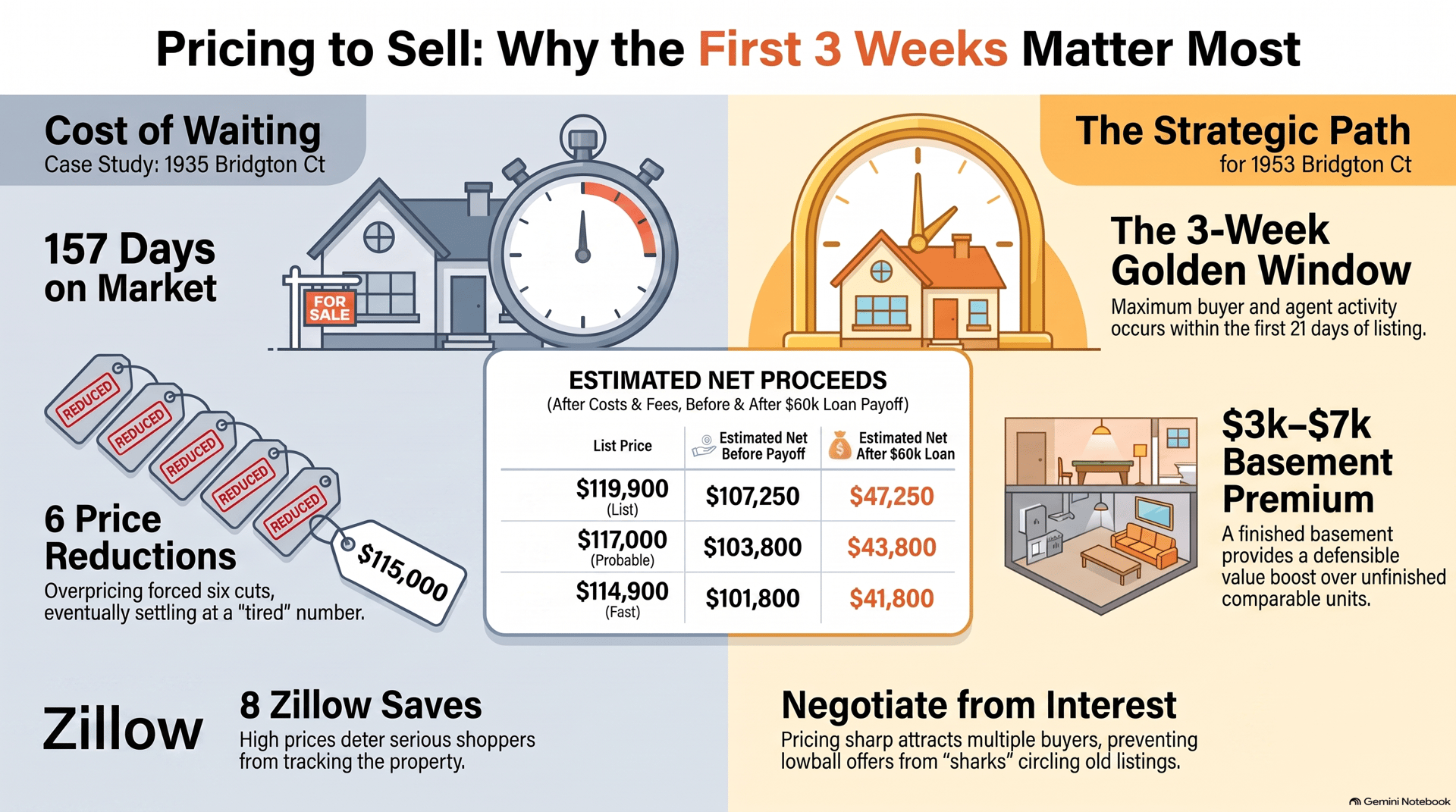
The first 21 days are the peak window. That is when saved-search alerts fire, serious shoppers rearrange their weekends, and the agents with ready buyers tour the new inventory. Price to the market and you control the room. Overprice, and you hand the room to the calendar.
Why the first 21 days are the whole fight
Most of a listing’s showing traffic arrives while the home is still marked new. Industry pattern is blunt: a large share of total showings cluster in the first 10 to 21 days. After that, the listing drops off the “just listed” alerts and starts competing with every other tired property in the same price band.
Window | Who shows up | Your leverage |
|---|---|---|
Days 1–7 | Saved searches, active buyers, listing agents with clients already in the car | Highest. Fresh photos. No baggage. |
Days 8–21 | Second-wave shoppers comparing you to whatever else just came out | Still strong if activity is real. Decision point if it is not. |
Day 22+ | Fewer emotional buyers. More investors. More “what’s wrong with it?” | You are no longer selling the house. You are selling the wait. |
In ZIP 46219, recent market pace has run near 24 days to pending on a typical sale. That is the neighborhood average — not a permission slip to sit for five months. A listing that is still hunting for a buyer at day 50 is already behind the local clock.
Your price writes a story. The market reads it out loud.
A property that fails to capture interest in its first three weeks drifts into the doldrums. That is not a quiet pause. It is a change in who is allowed to set the terms.
Once a property sits, the sharks smell it. They do not offer your number. They offer the tired number, then ask for repairs on top of it. That is the doldrums, and it is expensive.
In that phase you are no longer negotiating the value of the home. You are negotiating the cost of the extra weeks. Low offers arrive with inspection credits attached because the buyer can see, in public, that nobody else has claimed it.
Price it correctly as the best house available, and the opposite happens. Activity stacks. Agents hurry their people. The market can push you toward the top of the honest range instead of dragging you through cuts.
A finished basement is a premium. It is not a new ceiling.
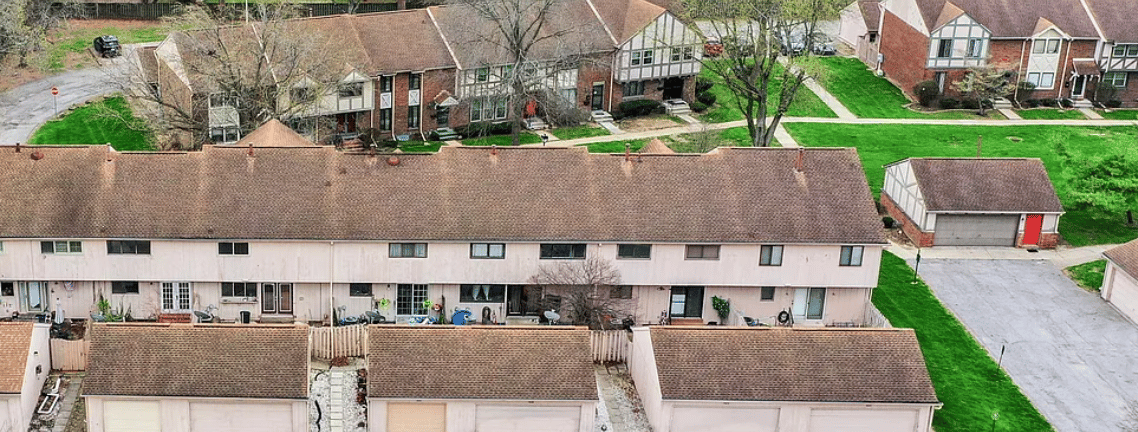
Take two units on the same Indianapolis court: 1953 Bridgton Ct and 1935 Bridgton Ct. Same era. Same attached product. Same basic footprint — two bedrooms, 1.5 baths, about 1,782 square feet. One difference that actually shows: 1953 has a finished lower level. 1935 does not.
That finish is real. Buyers feel it on the tour. It is worth something. In this building, the honest premium for a finished basement plus a clean rehab is about $3,000 to $7,000 — enough to win the tie-breaker, not enough to ignore what the last comparable already proved.
Feature | 1935 Bridgton | 1953 Bridgton |
|---|---|---|
Beds / baths / size | 2 / 1.5 / ~1,782 sq ft | 2 / 1.5 / ~1,782 sq ft |
Basement | Unfinished | Finished |
Market story | Opened at $144,900 · six cuts · 157 days · 8 Zillow saves · pending $115,000 with concessions | The better house on the court — if it is priced like one |
What the finish can add | — | $3,000–$7,000, not $15,000 |
A finished basement helps a buyer choose you. It does not let you outrun what lenders and appraisers can defend against a pending neighbor at $115,000.
The cautionary listing: 1935 Bridgton Ct
If you want to see what “testing the market” costs, look at 1935. It did not fail because the court is unsellable. It failed the opening number, then spent five months teaching every buyer the next number would be lower.
1935 Bridgton — list price over time
Pending at $115,000 after 157 days and eight Zillow saves. That is not demand. That is attrition.
Eight saves in five months is the market whispering. By the time the price became realistic, the listing had already told the room it would wait. A pending $115,000 after that journey is not proof that $115,000 was the only possible number on day one. It is proof that a high open, followed by cuts, spends the good weeks you never get back.
The worksheet sellers skip: list price is not net
Sellers often start with a number they want to clear after fees, then work backward until the list price looks like a wish. In Indianapolis, a 6% total commission plus title, HOA transfer, tax proration, a buyer credit, and a modest inspection allowance is unforgiving at this price point.
Here is a real worksheet on a Bridgton-style sale with a $60,000 loan payoff. To clear $115,000 after selling costs, before the mortgage, the contract has to be about $129,000.
Path | Contract | Net before loan | After $60k payoff |
|---|---|---|---|
The number that hits a $115k after-fee target | $129,000 | $115,000 | $55,000 |
List as the best house on the court | $119,900 | $107,250 | $47,250 |
Probable contract if activity is healthy | $117,000 | $103,800 | $43,800 |
Sharp list for speed | $114,900 | $101,800 | $41,800 |
The gap between a $115,000 after-fee target and what a strong, timely sale actually leaves before the loan is about $8,000 to $11,000. That is not a negotiation gap. It is the building’s proven ceiling plus five months of evidence from the unit next door.
Forcing $129,000 is not a strategy. It is a request that buyers ignore a pending $115,000 unfinished comparable and a 157-day listing that collected eight saves.
Two paths that keep you in control
You do not “try” a price. You choose whether you want to lead the first 21 days or be chased after them.
Path 1 — Market leader at $119,900
Lead with the finished basement at a number a buyer can defend to a lender. Capture the first wave. Negotiate from showings, not from silence. Honest range: $117,000 to $119,900.
Path 2 — Sharp entry at $114,900
Price for velocity. Shortest days on market. Least room for a lowball once the first wave has passed. You trade a little list-price theater for a cleaner, faster close.
Both paths respect the court. A list in the high $120s does not. It asks the market to pay a number 1935 already spent 157 days failing to attract.
The market is the only truth-teller in the room
Testing the market is often just taxing the profit. Price correctly on day one and the upgrade gets paid for. Price for a fantasy net and you pay for the wait — in cuts, in credits, and in the offers that only arrive after the sharks have had a look at the calendar.
Would you rather chase a number the last comparable already rejected, or take the highest return available while the listing is still new?
If you are weighing list price against days on market in Indianapolis, Lebanon, or anywhere in the metro, I will run the net sheet before the sign goes up — not after the listing has gone quiet.
Cara Conde, Broker
(317) 999-9888
caraconde.com · Contact
Google profile